Latest Scientific Discoveries

All News →
Scientists map the changing sounds of the Arctic to strengthen global monitoring
Science News

Scientists map the changing sounds of the Arctic to strengthen global monitoring

As Arctic sea ice retreats, new shipping routes, expanding resource development and growing geopolitical competition are transforming one of the world's least-monitored regions. Scientists at Los Alamos National Laboratory have established one of the first long-term acoustic baselines for the Arctic's underwater soundscape. This work strengthens the detection and interpretation of earthquakes, underwater and nearshore detonations, ship traffic and other events of national security interest.

📅 2026-09-24 21:40:05    •    Phys.org
Higher-dimensional black holes hide an exact symmetry in their ringing, and string-inspired gravity breaks it
Science News

Higher-dimensional black holes hide an exact symmetry in their ringing, and string-inspired gravity breaks it

Strike a bell, and it rings with a pitch and a fading that tell you about the bell: its size, its shape, the metal it is made of. Black holes ring too. When two merge, the newborn black hole shivers and sheds gravitational waves in a brief, dying chord, and since 2015, gravitational-wave detectors have been listening. The notes of that chord, which physicists call quasinormal modes, depend only on the black hole's mass and spin and on the law of gravity itself. Change the law, and the chord changes.

📅 2026-09-24 21:20:04    •    Phys.org
Could warmer waters bring heavier coastal rain? Insights from Cyclone Shaheen simulations
Science News

Could warmer waters bring heavier coastal rain? Insights from Cyclone Shaheen simulations

A modeling study involving researchers from Sultan Qaboos University found that sea surface temperature and Oman's terrain influenced simulations of Tropical Cyclone Shaheen through different mechanisms, affecting its intensity, track and rainfall distribution. The researchers chose Tropical Cyclone Shaheen, which directly affected northern Oman in October 2021, as a case study to examine how changes in environmental and surface conditions influence regional weather model simulations.

📅 2026-09-24 21:20:01    •    Phys.org
3D-printed scaffolds help turn waste methane into useful chemical using less power than liquid reactors
Science News

3D-printed scaffolds help turn waste methane into useful chemical using less power than liquid reactors

When landfills and wastewater treatment plants create methane as a byproduct, much of it is simply burned and its value is lost. But the gas is an energy-rich resource that could be recycled as a fuel, chemical feedstock or bioproduct. Capturing and converting waste methane offers an opportunity to recover energy and create useful products from an otherwise wasted gas stream.

📅 2026-09-24 21:00:01    •    Phys.org
Archaeologists discover 'tomb of the very highest rank' in 2,700-year-old Etruscan cemetery
Science News

Archaeologists discover 'tomb of the very highest rank' in 2,700-year-old Etruscan cemetery

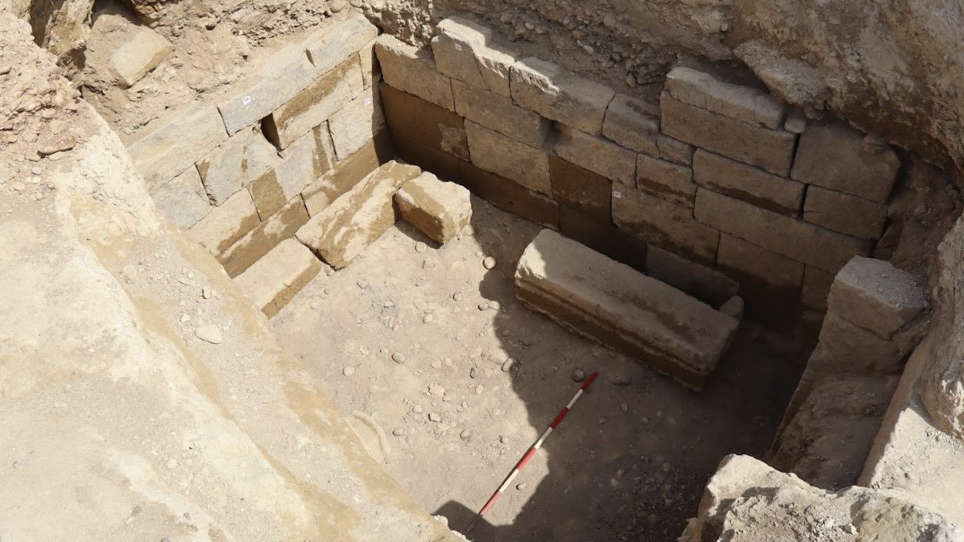
Archaeologists have unearthed a monumental 2,700-year-old tomb at Vulci, an important ancient Etruscan town north of Rome. Despite repeated attempts by tomb robbers to loot this burial over the centuries, the tomb still contained a massive collection of grave goods, including weapons, gold and bronze plates, chariot parts, a rare pair of women's shoes, and a complete banquet set.The burial, nicknamed the Tomb of the Stone Chamber, was excavated this summer, according to a translated statement from the Italian Superintendency of Archaeology, Fine Arts and Landscape for the Province of Viterbo and Southern Etruria (SABAP-VT-EM). But the discovery builds on work that French archaeologists carri...

📅 2026-09-24 20:59:43    •    Live Science
New findings explain how cells assemble machinery to repair damaged DNA
Science News

New findings explain how cells assemble machinery to repair damaged DNA

A cell's ability to repair its damaged DNA is one of the most fundamental processes in biology, helping protect us from diseases like cancer. Over the years, researchers have unraveled many of the mechanisms cells use to repair DNA, ultimately leading to precision cancer treatments.

📅 2026-09-24 20:40:11    •    Phys.org
AI-guided mutations help viruses infect bacteria up to 1 million times more effectively
Science News

AI-guided mutations help viruses infect bacteria up to 1 million times more effectively

Biochemists at the University of Wisconsin–Madison are using AI to tackle one of modern medicine's most pressing challenges: the rise of antibiotic-resistant bacterial infections. Using data collected in their lab, biochemistry professor Vatsan Raman and his team built an AI model to identify new possibilities for fighting bacteria with one of their natural enemies. Their findings, published in the journal Cell Systems, could help accelerate the development of alternatives to traditional antibiotic drugs.

📅 2026-09-24 20:30:01    •    Phys.org