Latest Scientific Discoveries

All News →
More moral language doesn't always mean more engagement online
Science News

More moral language doesn't always mean more engagement online

Moral language—words and phrases that express ideas about right and wrong, virtues, fairness, harm and social obligations—is widely used in social media posts and other online content. Posts containing moral language sometimes spread quickly and attract a lot of attention on social media, yet whether moral language is always linked to greater user engagement remains unclear.

📅 2026-09-27 16:10:01    •    Phys.org
How has evolution shaped men's and women's minds? A new book tells an outdated story
Science News

How has evolution shaped men's and women's minds? A new book tells an outdated story

Psychologist Steve Stewart-Williams' third book about evolutionary psychology, a controversial field often drawn on (and distorted) by the manosphere, is A Billion Years of Sex Differences: How Evolution Shaped the Minds of Men and Women. It's primarily interested in three questions.

📅 2026-09-27 16:00:01    •    Phys.org
Waste bulrush transformed into copper-enhanced material for dye removal from wastewater
Science News

Waste bulrush transformed into copper-enhanced material for dye removal from wastewater

Industrial activities such as textile manufacturing, paper production, leather processing and food processing can generate wastewater containing synthetic dyes. Because many synthetic dyes are chemically stable, difficult to biodegrade and environmentally persistent, their release into waterways can pose risks to aquatic ecosystems and human health.

📅 2026-09-27 14:30:05    •    Phys.org
Astronomers discover a radio galaxy with evidence of four separate jet outbursts
Science News

Astronomers discover a radio galaxy with evidence of four separate jet outbursts

Astronomers have identified what may be the first example of a new class of radio galaxy, one whose central black hole appears to have launched powerful jets on four separate occasions. High-resolution observations with the upgraded Giant Metrewave Radio Telescope (GMRT), combined with data from MeerKAT and the Very Large Array, reveal four pairs of radio structures arranged symmetrically around the central galaxy.

📅 2026-09-27 14:20:05    •    Phys.org
Glucosamine, a popular joint supplement, linked to faster Alzheimer’s progression
Science News

Glucosamine, a popular joint supplement, linked to faster Alzheimer’s progression

A large health-record analysis found that glucosamine use was associated with a 25% higher likelihood of mild cognitive impairment progressing to dementia. Lab experiments suggest the popular joint supplement may intensify an abnormal sugar-tagging process in the Alzheimer’s brain, although researchers say clinical trials are needed to determine whether it actually causes harm.

📅 2026-09-27 13:53:39    •    ScienceDaily
Atrial fibrillation patients saw 69% lower risk with common blood thinners
Science News

Atrial fibrillation patients saw 69% lower risk with common blood thinners

Direct oral anticoagulants cut the risk of serious clinical events by 69% in atrial fibrillation patients with an intermediate risk of stroke, according to the randomized SINGLE-AF trial. The benefit was driven mainly by fewer ischemic strokes, with no increase in major bleeding.

📅 2026-09-27 13:41:36    •    ScienceDaily
One CRISPR treatment cut “bad” cholesterol in half for a full year
Science News

One CRISPR treatment cut “bad” cholesterol in half for a full year

A single dose of an experimental CRISPR therapy cut LDL cholesterol and triglycerides by about half in patients with difficult-to-treat lipid disorders. The reductions were still present one year later, with the highest dose lowering LDL by 52.5% and triglycerides by 47.8%.

📅 2026-09-27 13:15:21    •    ScienceDaily
New soil test could reveal how soil microbes help feed plants
Science News

New soil test could reveal how soil microbes help feed plants

Scientists have streamlined a method for measuring DNA-bound phosphorus in soil, making it cheaper and easier while preserving its accuracy. The technique could reveal how soil microbes help recycle phosphorus and ultimately support more sustainable fertilizer and nutrient management.

📅 2026-09-27 12:10:17    •    ScienceDaily
DNA reveals chemosynthesis genes in bacteria living on coral reef fish gills
Science News

DNA reveals chemosynthesis genes in bacteria living on coral reef fish gills

Chemosynthetic bacteria have been documented in various marine environments and in association with invertebrate hosts such as annelid worms and mollusks, but their presence in fish appears to be a new discovery. The findings show that fish gills host a complex and specialized microbiome that is not yet well understood but could play an important role in fish metabolism, immunity and health.

📅 2026-09-27 12:00:05    •    Phys.org
A giant cosmic 'fart' is making a wobbling zombie star repeatedly flash us, 'groundbreaking' observations reveal
Science News

A giant cosmic 'fart' is making a wobbling zombie star repeatedly flash us, 'groundbreaking' observations reveal

An enormous, ongoing cosmic "fart" is causing a mysterious zombie star to flare up repeatedly, shining bright pulses of X-rays toward Earth, a new study reveals. The unprecedented observations shed light on how some of the universe's most extreme objects interact with one another. Around 13,000 light-years from Earth lies an unusual binary star system, known as BP Crucis. It contains a blue hypergiant star roughly 60 times larger than the sun, dubbed Wray 977, alongside a neutron star — the undead and ultradense remains of a star that exploded via a supernova — that astronomers have labeled GX 301-2. This stellar "zombie," which contains the same mass as our home star packed into an object r...

📅 2026-09-27 12:00:00    •    Live Science
1.7-billion-year-old fossils reveal a crucial clue to the rise of complex life
Science News

1.7-billion-year-old fossils reveal a crucial clue to the rise of complex life

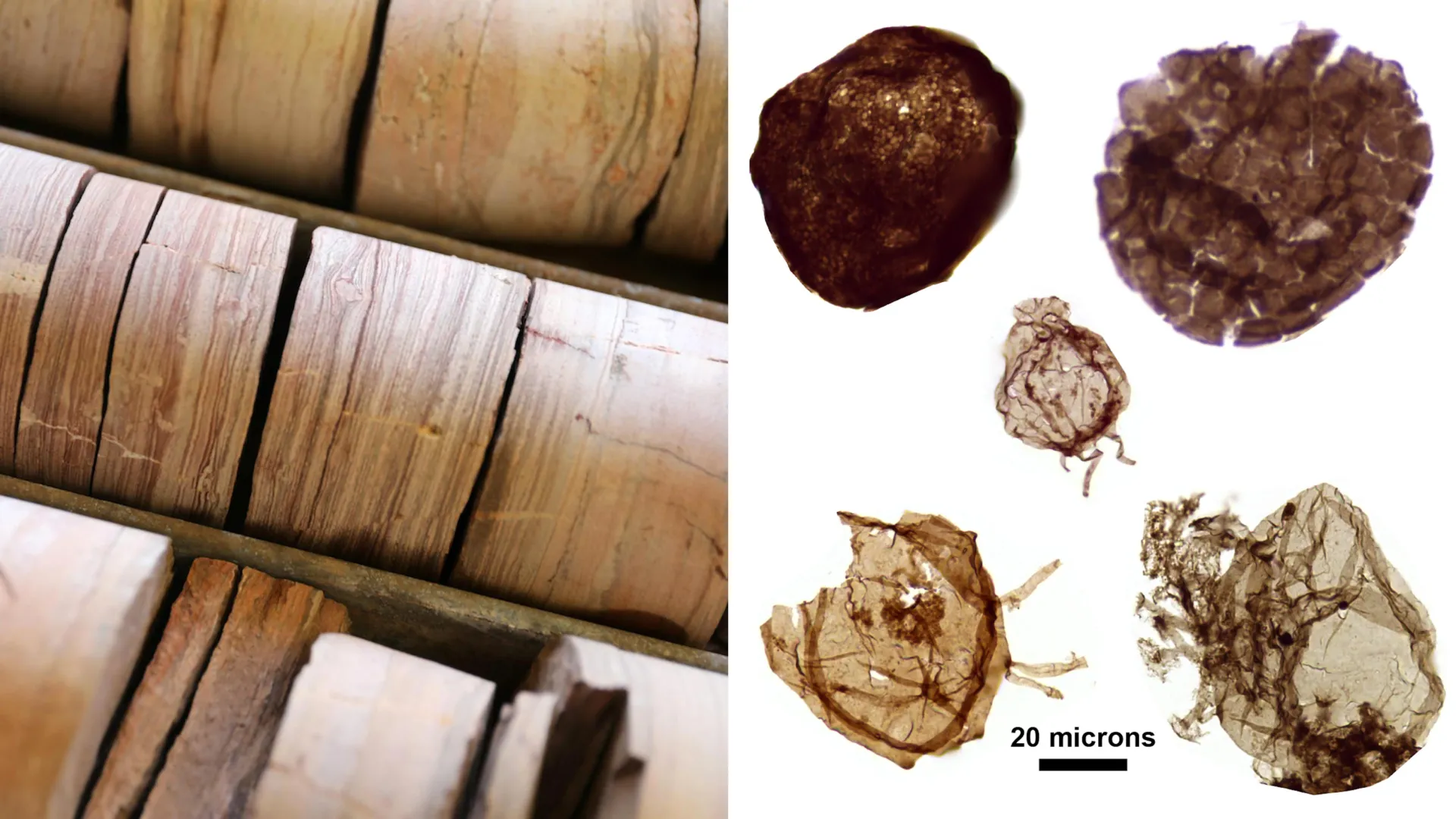
Scientists studying ancient Australian rocks uncovered more than 12,000 fossils from some of the oldest known eukaryotes on Earth. These early complex cells lived in settings ranging from coastal mudflats to the open sea, but only where oxygen was available. Oxygen-free environments contained simpler microbes instead. The findings strengthen the idea that oxygen played a crucial role in the emergence of complex life.

📅 2026-09-27 11:55:50    •    ScienceDaily