Science News

Latest science news, discoveries and scientific developments.

Big dogs age faster at an epigenetic level, new study finds
Science News

Big dogs age faster at an epigenetic level, new study finds

Great Danes and mastiffs rarely live more than a decade, while Chihuahuas can live twice as long. Exactly why big dogs die younger than small ones do has been unclear — but new findings may help to solve that mystery.The research, published Thursday (Oct. 8) in the journal Science, looked at a chemical code written on top of dogs' DNA. This code, called the methylome, consists of chemical tags called methyl groups, which bind to DNA's building blocks. Proteins constantly access DNA, loading up the information written in its code and taking that data away to be turned into new proteins for the cell. But these methyl groups can act as tiny roadblocks that stop that process in its tracks. These...

📅 2026-10-08 21:59:11    •    Live Science
Lensless imaging method enables long-term monitoring of living cells without staining
Science News

Lensless imaging method enables long-term monitoring of living cells without staining

In a study led by Tampere University, researchers have developed a new lensless imaging method that produces precise quantitative data on living cells from a single image. The compact system can be placed inside a standard cell-culture incubator, allowing living cells to be monitored continuously for hours or even days without staining or other labels. The research is published in the journal Applied Physics Letters.

📅 2026-10-08 21:50:01    •    Phys.org
Atlantic weather pattern shaped southern Greenland's rain and snow for millennia, sediments reveal
Science News

Atlantic weather pattern shaped southern Greenland's rain and snow for millennia, sediments reveal

In high-latitude coastal areas, Arctic amplification means that temperatures are rising faster than the global average. This combination of rising temperatures and changing precipitation patterns driven by the North Atlantic Oscillation has major impacts on regions with a "cryosphere"—areas that host ice sheets and glaciers, such as southern Greenland.

📅 2026-10-08 21:40:21    •    Phys.org
Do we all see anger the same way?
Science News

Do we all see anger the same way?

Happiness, sadness, disgust, surprise, fear, contempt and anger. These are the basic emotions traditionally associated with facial expressions described as universal. As important social signals, facial expressions help us rapidly interpret the emotions and intentions of others. Among these emotions, anger holds a particularly relevant role because it often signals interpersonal threat or conflict.

📅 2026-10-08 21:40:02    •    Phys.org
Real-time oxygen measurements expose hidden losses in solar water splitting
Science News

Real-time oxygen measurements expose hidden losses in solar water splitting

A new technique developed at Imperial College London measures oxygen production in real time, revealing hidden losses in solar water splitting. The researchers found that electrical current did not always correspond to oxygen generation in hematite, one of the most widely studied materials in the field, revealing a previously unknown limitation in the reaction.

📅 2026-10-08 21:30:01    •    Phys.org
Nitrogen fixation 'off switch' discovery could one day help crops make their own fertilizer
Science News

Nitrogen fixation 'off switch' discovery could one day help crops make their own fertilizer

Nitrogen is essential for life. It's needed to build proteins, DNA and many other components of cells. Although nitrogen gas makes up almost 80% of Earth's atmosphere, most organisms cannot use it directly. Certain microbes solve this problem through a process called nitrogen fixation, which converts nitrogen gas into ammonia. This process is carried out by an enzyme called nitrogenase.

📅 2026-10-08 21:20:21    •    Phys.org
How enzyme activity can accelerate molecular movement inside cells
Science News

How enzyme activity can accelerate molecular movement inside cells

A cell sitting in fluid looks like one of the most passive things in biology. Nutrients drift toward it on the aimless currents of molecular motion, and now and then one bumps into the right spot on the cell's surface and gets pulled inside. This impression of the cell as a lottery run by chance, with the molecules wandering and the cell waiting, is a misconception.

📅 2026-10-08 21:20:02    •    Phys.org
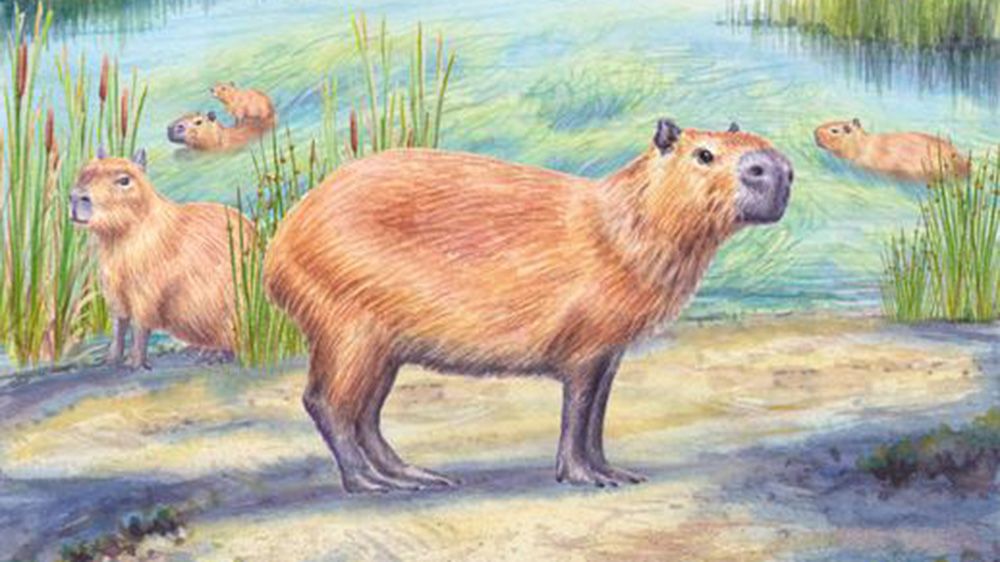
'Freakish' discovery of 9 million-year-old capybara tooth supports idea that Atacama wasn't always a desert
Science News

'Freakish' discovery of 9 million-year-old capybara tooth supports idea that Atacama wasn't always a desert

An illustration of ancient capybaras enjoying coastal wetlands, which may have looked somewhat like the Atacama Desert around 9 million years ago. (Image credit: Mauricio Alvarez)Researchers have discovered a roughly 9 million year old tooth belonging to a large, water-loving relative of modern day capybaras in the Atacama Desert of northern Chile. The fossilized molar adds to previous evidence suggesting that it's unlikely the Atacama, one of the driest places on Earth, was continuously dry for the last 40 million years.The Atacama Desert, possibly the oldest desert on Earth, takes up the northern third of Chile. It's bounded by the Chilean Coast Range to the west, which blocks rain from th...

📅 2026-10-08 21:19:31    •    Live Science
Health-promoting imprisonment is being deprioritized, researcher claims
Science News

Health-promoting imprisonment is being deprioritized, researcher claims

For several decades, Norwegian prison research has focused on the pains of imprisonment, isolation and the harm that prison does. But what is needed for a prison to actually promote health, personal growth and hope? Research shows that what is needed is something quite different from the developments currently underway in Norway.

📅 2026-10-08 21:00:13    •    Phys.org
How companies drift into unethical behavior
Science News

How companies drift into unethical behavior

Unethical behavior inside organizations is often less sudden than companies assume. New research from ESMT Berlin shows how employees can collectively drift into misconduct as groups gradually reshape what they perceive as ethical or acceptable.

📅 2026-10-08 20:40:16    •    Phys.org
How information is written in ferroelectric memory at the nanoscale
Science News

How information is written in ferroelectric memory at the nanoscale

What happens at the nanoscale when information is written to memory? Researchers at KAIST have shown how tiny regions with a new polarization direction form while previously formed regions continue to expand in a promising ferroelectric material. By linking these nanoscale changes to electrical measurements, the team developed a model that captures both processes, offering a basis for designing faster and more stable memory.

📅 2026-10-08 20:40:10    •    Phys.org
Study shows how children learn to talk about characters' thoughts and feelings in stories
Science News

Study shows how children learn to talk about characters' thoughts and feelings in stories

An international research effort has examined how children develop the ability to express what story characters think, feel and perceive. Research groups from around the world collected 5,507 picture-based stories from 2,763 typically developing monolingual and bilingual children ages 3 to 13. The children came from 32 countries and spoke 44 languages.

📅 2026-10-08 20:20:18    •    Phys.org
Tracking down cellular gene functions with AI and microscopy
Science News

Tracking down cellular gene functions with AI and microscopy

A new technology promises to enable more comprehensive investigations into how individual genes determine the appearance and behavior of cells. Researchers led by professor Veit Hornung at LMU's Gene Center and professor Matthias Mann at the Max Planck Institute of Biochemistry in Martinsried, together with professor Fabian Theis at Helmholtz Munich, have developed SPARCS, a technology that combines artificial intelligence with microscopy and genetic screening.

📅 2026-10-08 20:20:12    •    Phys.org
Rule gives every generation same share of its best attainable welfare
Science News

Rule gives every generation same share of its best attainable welfare

Sharing a finite resource across generations requires a balance between today's needs and the claims of those yet to be born. Research by Prof. Thomas A. Weber, presented at the 2026 European Control Conference in Reykjavík, proposes a fair allocation rule that gives every generation the same fraction of its best attainable welfare. The approach preserves access for all future generations and provides a performance guarantee without requiring agreement on a single social objective.

📅 2026-10-08 20:00:21    •    Phys.org
Layered semiconductor unlocks magnetic control of light emitted by quantum condensates
Science News

Layered semiconductor unlocks magnetic control of light emitted by quantum condensates

Quantum technologies are considered key technologies of the future. However, research in this field requires not only scientific expertise but sometimes also highly specialized laboratory conditions. Bose–Einstein condensates are a remarkable example, in which atoms move in lockstep, making quantum-mechanical effects visible not only at the level of individual atoms but also on a macroscopic scale. The first Bose–Einstein condensates were observed in ultracold atomic gases at temperatures close to absolute zero. The cooling required to achieve this was technically demanding, costly and restricted to specialized laboratories.

📅 2026-10-08 20:00:11    •    Phys.org